
Every Last Drop
Tokenizing, Mapping, and Metering Water — From UN “Bankruptcy” Declaration to Total Control

In my last post, we explored the UN’s declaration of “Global Water Bankruptcy,” a permanent crisis condition requiring top-down monitoring of and enforceable limits on water usage, and a restructuring of water rights.
“For much of the world, ‘normal’ is gone,” according to Kaveh Madani, Director of the UN University Institute for Water, Environment and Health (UNU-INWEH). That “normal” historical baseline — water rights/shares, old allocation schemes, everything farmers and communities have relied upon for generations — is over. It’s gone.
Today (July 16, 2026), in NYC, the UNU-INWEH is hosting a side event “From Global Water Bankruptcy to Implementation: Regional Solutions and Opportunities to Accelerate Sustainable Development Goals.” The name itself makes clear these bureaucrats see a water crisis as a chance to advance their own agenda — and indeed, that no one will be “left behind” (excluded from their control):
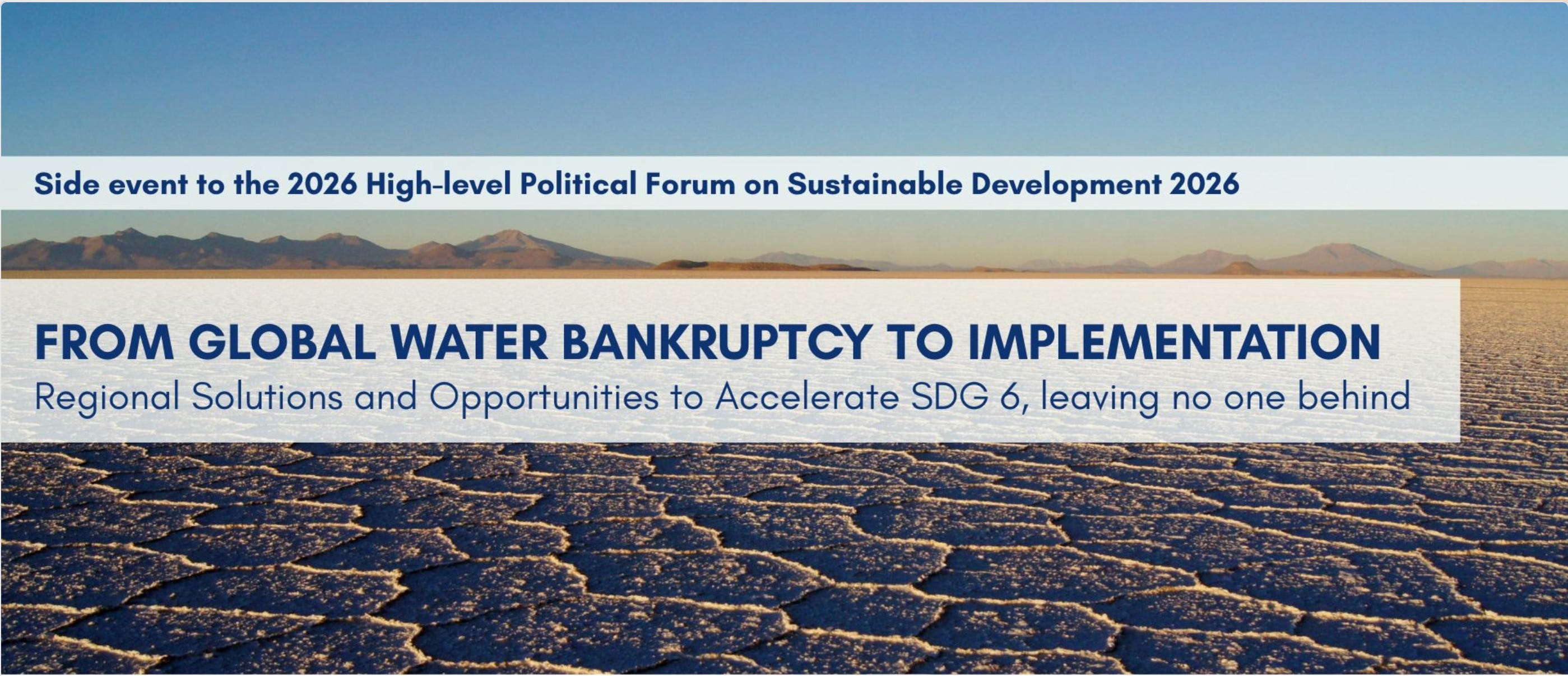
Why is water such a fantastic opportunity to advance the SDGs? Few have answered this question as well as Mariana Mazzucato (co-chair of the Global Commission on the Economics of Water) at a 2022 WEF event:
“Water is something that people understand. You know, climate change is a bit abstract; some people understand it really well, some understand it a bit, some just don’t understand it. Water… every kid knows how important it is to have water: when you’re playing football and you’re thirsty, you need water. So there’s also something about really getting citizen engagement around this and really in some ways experimenting with this notion of the common good. Can we actually deliver this time in ways that we have failed miserably other times?”
Water, in other words, is their perfect testing ground: tangible, emotional, and universal.
Water rights have historically been tied to the land: rainwater capture, private wells, or at most local controls on surface water kept water sovereignty in our own hands. Now, however, as with food and energy, we are being told that the issue is too important—too global—to leave in our unqualified hands. The message is clear: we have gone bankrupt, it is our fault, and they are here to rescue us by centralizing control.
Tokenizing Water
The WEF estimates that the global need for cumulative total investment through 2040 in a “just transition to equitable water infrastructure” is €11.4 trillion. Panelists on their round tables don’t know where the money will come from (though they insist the cost of not improving governance is far higher). This is where the financial engineers step in.
According to a May, 2026 report from Goldman Sachs entitled, “Securing and Financing the Future of Water,” the way to finance this transition is by tokenizing water to create investment opportunities in this new infrastructure:
As in other markets, tokenization is also emerging as a promising approach to challenges facing water markets. Tokenization can be used both to solve challenging water market issues—for example, by injecting liquidity and turning rights into traceable tokens that track water use across market participants and at different jurisdictional layers—and water infrastructure financing challenges. Tokenized financing can deliver credits for companies that conserve or recycle water through connections to flow meters.
Goldman points at the UAE, who is testing a water-backed digital token that links verified physical water volumes to a tradable digital asset.
In fact, crypto providers like ChainLink have defined Water Tokens, promising that companies who use water could “purchase tokenized water credits [to] transparently offset their water usage … allowing companies to prove their ESG commitments to investors.”
Portugal’s leading wastewater management provider, Indaqua, is tokenizing wastewater volume on the Algorand blockchain, “enabling companies to offset their water footprint.”
If it sounds a lot like carbon allowances, ESG scores, and carbon markets — that’s because it is.
To tokenize and track every drop of water on Earth, however, they’d first need to figure out what is where now. And that’s what they’re working on now.
Water Mapping
Across the United States, local news reports have assured residents that there is no reason for alarm as helicopters appear overhead with giant antennas or survey equipment:
Notably, however, there has been no national news coverage of the fact that this is happening everywhere. From California’s Statewide Airborne Electromagnetic (AEM) Surveys Project, to Kansas Geological Survey’s mapping of the Ogallala aquifer, to groundwater surveys in Michigan, Missouri, Wyoming and Colorado, New Mexico and Texas, the story is the same: “Nothing to see here!”
“Groundwater is a vital resource for New Mexico’s communities, agriculture, and ecosystems, and unlocking its full potential requires reliable data. By mapping aquifers and establishing a long-term monitoring network…”
— New Mexico’s Aquifer Mapping and Monitoring Program (AMMP)
Yet, stepping back from the compartmentalization, it is clear that there is a comprehensive mapping being performed right now — across many different organizations, but clearly driven top-down — to identify every source of water.
Once they map out where the water is now and have markets to trade tokenized water, the final piece is real-time usage tracking.
Monitoring & Enforcement
Oracle Utilities is one of the leading platforms for ingesting and analyzing high-frequency meter data. Their Meter Data Management system is live at over 100 utilities worldwide, processing data from more than 115 million meters. Water metering has been a deliberate expansion area for over a decade.
Oracle has trained AI models on this usage data, affording utilities the ability to detect broken pipes or outdoor irrigation and support the kind of granular “transparent accounting” called for in the Global Water Bankruptcy framework.
What’s stunning about this infrastructure is that water use can be tracked (and limited) at a personal allowance level across sources. You may be allocated N gallons a week, whether pulled from a private spring or well or a municipal water supply.
I’ll cover Oracle more in my next post. For now, it is safe and accurate to say that the infrastructure for surveillance of water usage has been under development for decades.
Water Sovereignty
The pieces are coming together as we speak: a bankruptcy declared from the top, your water rights nullified, public buy-in tested through the language of “common good,” new markets ready to tokenize and trade every drop, active mapping of current water sources, and AI-driven metering infrastructure capable of enforcing limits across municipal and private sources alike.
The crisis rhetoric has been invoked because the system is nearly operational and needs only to be unveiled. But this is not a well-intentioned crisis response; it is the architecture for measurable, enforceable, financialized governance of a basic necessity. Water is being transformed from a resource tied to land and people into a centrally tracked, rationed, and tradable asset.
The only real question left is whether enough people will see the shift for what it is — and insist that water sovereignty must remain where it has always belonged: with the land and the people whose lives actually depend on it.
I very much welcome your thoughts — comment below. 🙏
Connect with me: on X @UnshadowedShow | Telegram | Discord
Support the broadcast: https://unshadowed.org/support
Get in touch: iceagefarmer@protonmail.com
Wearable Intellectual Ammunition: https://unshadowed.org/shop
UK here. I'm getting texts on behalf of water company to replace existing meter inside my home for a SMART one. I've just watched promotional video, about saving water, being able to locate leaks quicker, all sounds marvellous. Installation consists of replacing meter, affixing a receiver/antennae on roof, access to electricity - meter uses 7w per day, around £20 per annum, the installer said, not charged to customer??? Using customer electricity so how does that work? I certainly don't get these carbon taxes/credits, supposed offsetting/tokenisation business. I don't think majority do so not many comments. Obviously, being able to shut off someone's power or water is worrying, if rationed, but from a privacy point of view, your personal habits, like bed time, how many baths or showers you take, washing loads, or vacations, will, or could easily be known.
They were looking for an enemy to unite humanity. They made us the enemy.
.
The Common Enemy of Humanity is Man
.
We came up with the idea of pollution, global warming, 💦 water shortages, famine and the like will fit the bill.
.
They made us the enemy of the world
.
🟥 🎥 MEGA UK COLUMN SANDI ADAMS
https://mega.nz/folder/AjNhgAaS#DQY4aheCIRgLOQ-wf4jF1Q